
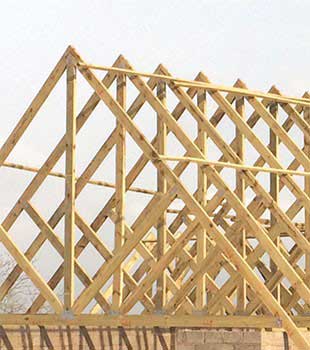
When people think about roof trusses, they picture the triangular frames that hold up tiles or sheeting. What they do not always notice is the hardware that makes a truss act like a single, engineered structure. That hardware is often referred to as a truss joiner.
A truss joiner might look like a simple plate or bracket, but it plays a major role in strength, stability, and long-term performance. In this guide, we explain what a truss joiner is, the different types used in South African roofing, the benefits they provide, and what to consider so your truss system performs the way it was designed to.
What is a truss joiner?
A truss joiner is a connector used to join truss members together or to connect trusses to supporting elements. In timber trusses, the most common truss joiner is a pressed steel plate with teeth that embed into the timber. In other situations, a truss joiner can also be a bracket, strap, hanger, or gusset plate.
Truss joiners serve two main functions:
- They transfer forces between members so the truss behaves as one unit.
- They provide a repeatable, tested connection that reduces reliance on site improvisation.
Why truss joiners matter
A roof truss carries dead loads, live loads, and wind uplift. Those forces must travel through the chords and webs and pass safely through each joint.
Without a properly designed truss joiner, the joint can slip, rotate, or split the timber. That turns a stiff triangle into a flexible frame. Over time, that can lead to sagging roof lines, cracked ceilings, loose sheeting or tiles, and in severe cases, structural failure during storms.
In short, truss joiners are not accessories. They are structural components.
Common types of truss joiners
1) Gang nail plates (toothed truss plates)
This is the most common joiner used in prefabricated timber trusses. A toothed galvanised plate is pressed into the timber at a joint, usually from both sides. The teeth grip the fibres and transfer forces across the connection.
These plates are engineered for each node. Plate size, thickness, and tooth pattern are selected to match the forces at that joint, not simply to “hold it together”.
Best for: Factory-built timber trusses, most residential roofs.
2) Nail-on connector plates and flat straps
Where additional reinforcement is needed, nail-on plates or straps may be used. These can supplement a joint, tie members together, or provide additional resistance to uplift.
Straps are also common at supports to connect trusses to wall plates or ring beams in areas where wind uplift is high.
Best for: Tie-downs, bracing connections, and strengthening local zones.
3) Truss hangers
A truss hanger is a formed metal bracket that supports a truss where it frames into another member, such as a girder truss or a timber or steel beam. The hanger provides a defined seat and a specified fastener pattern, which makes the connection strong and repeatable.
Best for: Hip and valley junctions, girder truss connections, framing into beams.
4) Gusset plates (bolted or screwed)
Gusset plates are flat plates used to connect members, often in heavier timber framing or feature trusses. They may be visible or concealed, and they rely on bolts or screws rather than teeth.
This type of truss joiner is common in architectural timber frames where exposed joinery is part of the design.
Best for: Feature trusses, glulam structures, long spans with engineered joinery.
5) Steel brackets, cleats, and angle connectors
These connectors are used to tie trusses to supporting structures, align members, or support secondary components like purlins or bracing. They are especially helpful where forces are concentrated and where uplift must be resisted.
Best for: Support connections, alignment, and local reinforcement.
The benefits truss joiners provide
Faster construction and fewer site errors
Factory-built trusses using engineered plates and labelled layouts reduce on-site cutting and trial-and-error. Truss joiners create consistent joints, which speeds up installation and reduces rework.
Structural reliability
A well-specified truss joiner provides known capacity. That means the joint strength is not based on guesswork or “how many nails the crew felt like using”.
Better wind uplift performance
Tie-down straps, hangers, and correct fastener schedules are critical in South African wind zones. Truss joiners help transfer uplift forces safely into wall plates and ring beams.
Cleaner roof lines and better finishing
When joints do not slip, the roof remains straight. That reduces wavy sheet lines, cracked ceilings, and doors or windows that stick due to movement in the structure.
Improved durability
Correct coatings and compatible fasteners reduce corrosion risk. Proper joiners also prevent timber splitting and joint fatigue over time, especially in roof spaces that experience moisture cycling.
What to consider when specifying truss joiners
Match joiners to the truss design
Not all joints carry the same forces. A heel joint, a girder junction, and a web node are not equal. The joiner should be sized for the specific forces, not chosen by appearance.
Use compatible corrosion protection
Coastal and industrial environments require upgraded coatings to protect from corrosion. Fasteners must match the joiner’s coating class. Mixing incompatible metals or using the wrong screws can shorten lifespan.
Follow the full fastener schedule
Most connector capacities assume all specified holes are filled. Skipping fasteners reduces performance, especially under uplift.
Avoid on-site modifications
Bending plates, drilling new holes, or trimming members to “make it work” is risky. If a change is needed, it should be engineered and documented.
Keep documentation and QA records
Layout drawings, joiner schedules, and photos of critical connections help with certification, insurance, and future maintenance.
Conclusion
A truss joiner may be small, but it is one of the most important parts of a roof structure. It transfers forces, prevents joint slip, improves wind resistance, and keeps roof lines straight for the long haul. The best results come from using the right joiner for the right joint, installing the full fastener schedule, and keeping corrosion protection and documentation in order. If you want a roof system that is fast to install and built to last, truss joiners deserve the same attention as the trusses themselves.
FAQs
How to join trusses together?
Trusses are joined together as a system using permanent bracing, purlins or battens, and specified connectors at key junctions such as girder trusses. Individual timber trusses are typically assembled in the factory with toothed plates, then tied together on site through bracing and fixing schedules.
What are the plates called that join trusses together?
The most common plates are gang nail plates, also called toothed truss plates or nail plates. They are pressed into the timber to form strong, repeatable joints.
Can trusses be welded?
Timber trusses are not welded. Steel trusses can be welded in some fabrication methods, but many light-gauge steel truss systems use screws or proprietary connectors rather than welding. The chosen method depends on the system design and manufacturer specifications.
How to join a roof truss?
If you mean joining truss members, that should be done using engineered connector plates or gussets as per the truss design. If you mean connecting trusses to supports, use the specified straps, hangers, or brackets and install the correct fasteners in every required hole. Avoid ad hoc fixes.